
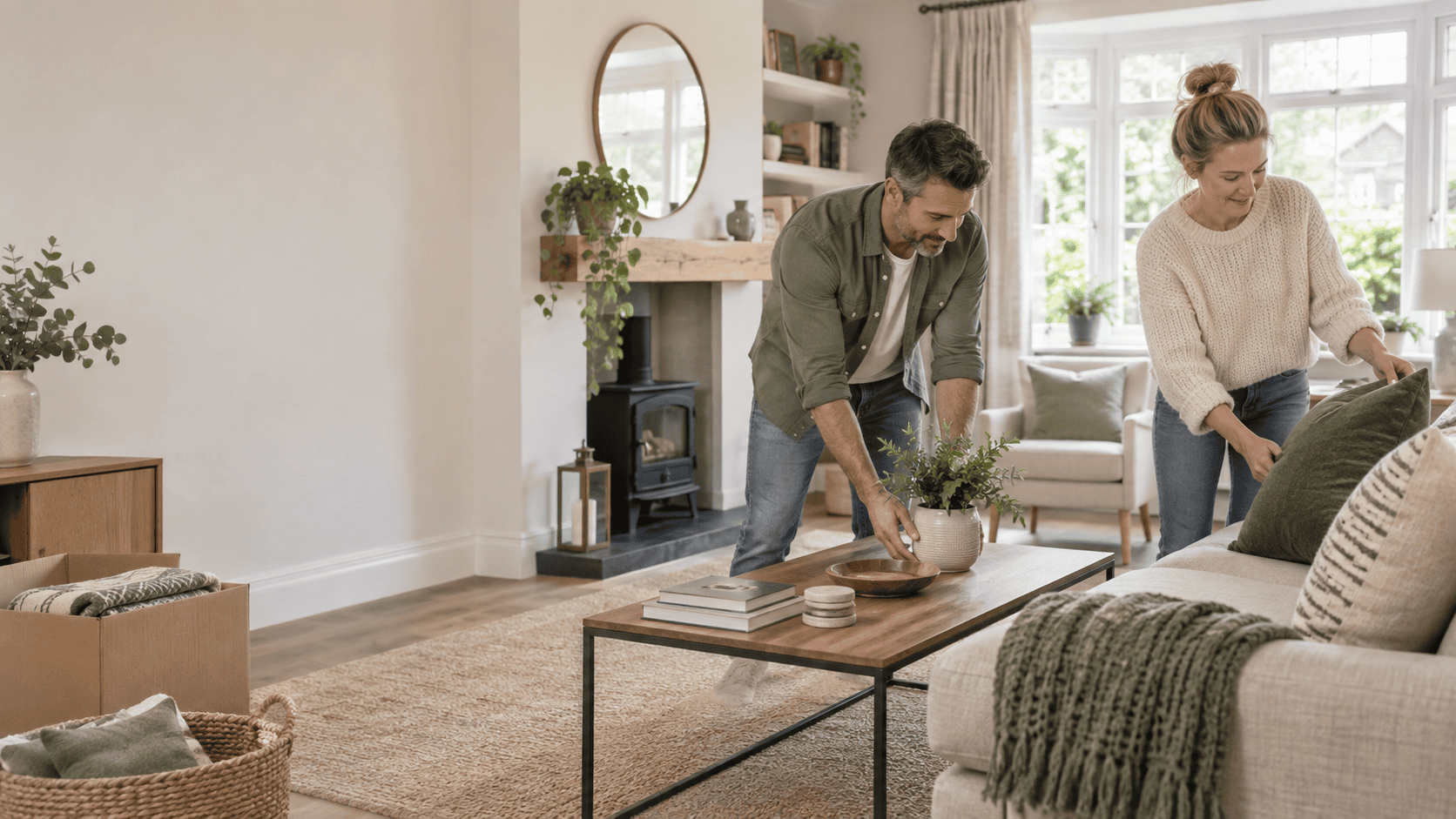
Selling a home and staging it are two different jobs happening at the same time. You still need to live there, cook and sleep there, while somehow making the place look like a show home for every viewing. Storage is the tool that makes both jobs possible at once. It gives everything that’s cluttering a room somewhere to go that isn’t the garage, the landing, or a box shoved under the bed before viewers arrive.
We’re Alexanders Removals & Storage, and this guide is deliberately practical rather than a list of statistics. If you’re weighing up whether staging is worth the effort at all, our Shrinking Homes report looks at just how tight London floor space has become, which is part of why staging and storage matter more here than almost anywhere else in the country. This piece is about what to actually do: room by room, in the right order, with the right kind of storage behind it.
Why staging matters when you’re selling
Staging, in practical terms, just means presenting a home so buyers can picture their own life in it rather than yours. Rightmove’s own guide for sellers puts decluttering near the top of its advice, noting that creating a sense of space and a neutral environment helps buyers imagine themselves living in a property, and specifically recommends removing or selling excess furniture from main living spaces, even if that means using temporary storage.
NAEA Propertymark, the professional body for UK estate agents, gives similar guidance to sellers: tidy cupboards, clear worktops, and present a home that lets its own features speak rather than competing with clutter for attention. Neither body puts a precise percentage on what decluttering adds to a sale. What both agree on, consistently, is that clutter works against you and a clear, neutral space works in your favour. That’s the principle this whole guide is built around.
Staging isn’t about hiding who you are or making a home feel cold. It’s about temporarily editing it, the same way you’d tidy before guests arrive, just more thoroughly and for longer. The difference between tidying for a dinner party and staging for a sale is really one of scale and duration, which is exactly where storage earns its place.
The psychology of viewings: what buyers actually notice first
Buyers form an impression within the first few seconds of walking through a door, well before they’ve consciously registered a single feature of the property. That first impression is almost entirely about space and light, not decor. A hallway stacked with shoes, coats and post makes a home feel smaller and less cared for before a buyer has even reached the living room.
This matters for storage because it tells you where to start. The instinct is often to tackle the messiest room first, but the smarter approach is to think about sequence: hallway, then the rooms a buyer sees earliest and most often on a typical viewing route, then the rest. A viewing is a journey through the property, and the first two or three rooms set the tone for how forgiving a buyer is about everything that follows.
It’s also worth remembering that buyers are trying to do two things simultaneously: assess the property honestly, and imagine themselves living there. Clutter interferes with both. It hides genuine features like fireplaces, alcoves and floor space, and it makes it harder to project a different life onto a room that’s still visibly full of someone else’s.
Room by room: living room and hallway
The living room is usually the room a buyer spends longest in, and the hallway is the room that sets their first impression before they’ve said a word. Together, they’re worth more staging effort than any other part of the house.
In the hallway, the aim is simple: remove anything that isn’t strictly necessary for that day. Shoes, coats, umbrellas, post and school bags should either be tidied into a single, closed storage solution or moved out entirely if there’s an excess of them. If a hallway has a cupboard under the stairs stuffed with vacuum cleaners, ironing boards and coats nobody wears, that’s a strong candidate for a storage unit rather than a rearrange, because buyers will open that cupboard and its size matters to them.
In the living room, focus on furniture first. Extra armchairs, a second coffee table, an oversized media unit, all of these make a room feel smaller than it is and harder to photograph well. Removing one or two large pieces of furniture, rather than just tidying what’s there, is usually the single most effective change you can make to how a living room reads in photos and in person. Bookshelves are worth a second look too: a shelf crammed with books, ornaments and framed photos reads as clutter even when every item on it is genuinely loved. Thinning it out, boxing it up and putting into storage anything that doesn’t need to be on display, makes the whole room feel calmer.
Personal photographs deserve their own mention. It’s natural to want family photos on display, but for staging purposes they work against you, because they constantly remind a buyer whose home this is rather than letting them picture it as their own. Boxing these up for storage, rather than just moving them to a drawer, keeps them safe and out of every room a buyer will walk through.
Room by room: bedrooms
Bedrooms pose a particular staging challenge: buyers open wardrobes. It’s one of the most consistent pieces of advice from estate agents, and it means a tidy-looking bedroom with an overstuffed wardrobe still fails the test the moment a buyer slides the door open.
Start with clothing volume rather than clothing tidiness. A wardrobe that’s roughly half full, with everything hung neatly and visible space either side, appears as generous storage. A wardrobe crammed floor to ceiling looks like inadequate storage, even in an otherwise spacious room. Moving out-of-season clothing, or simply clothing you’re not currently wearing, into a storage unit ahead of listing solves this directly, and it’s one of the easiest wins in the entire staging process because it doesn’t require any decisions about what to keep long term.
Children’s bedrooms need a lighter touch but the same principle. Toys, especially large ones like play kitchens, trampolines or oversized soft toys, dominate a small room’s visual space far more than their actual footprint suggests. Storing the toys that aren’t in daily use, rather than trying to arrange them neatly, usually does more for how the room presents.
Spare rooms are worth highlighting separately, because they’re often the room that’s been quietly used as a dumping ground for years. If a spare room currently functions as storage for exercise equipment, out-of-season decorations and boxes from the last house move, it’s effectively invisible as a bedroom to a buyer, and it’s one of the highest-value rooms to properly clear, since “an extra bedroom” is a genuine selling point that clutter can ruin.
Room by room: kitchen
The kitchen is consistently rated by estate agents as one of the two most important rooms in a sale, alongside the bathroom, and it’s also one of the quickest to transform through storage rather than renovation.
Worktops are the first priority. Small appliances, from slow cookers to air fryers to bread makers, accumulate on kitchen surfaces over years of normal use, and clearing them away, rather than just cleaning around them, makes the single biggest visible difference in kitchen photography and viewings. If a worktop appliance isn’t used weekly, it’s a reasonable candidate to go into storage for the duration of the sale rather than back into an already full cupboard.
Cupboards matter more than people expect, because buyers open them, particularly in a kitchen where storage space is often a genuine concern. Duplicate crockery, bulk-bought tinned goods, and the collection of takeaway containers nobody needed to keep all crowd out the visual sense of space a buyer is looking for. Thinning these out, whether into storage or genuinely discarding what’s surplus, makes cupboards look generous rather than cramped when opened.
If the kitchen doubles as a dining space, the table itself is worth considering. An oversized table that dominates the room can make an otherwise well-proportioned kitchen feel tight. Swapping to a smaller table, or removing extra chairs, for the duration of the sale is a common staging move that a storage unit makes straightforward.
Room by room: garden, shed and loft
Outdoor and overflow spaces are easy to overlook, but they’re exactly the areas where clutter accumulates fastest and where buyers, particularly in London, pay close attention, because garden space and storage capacity are both genuinely scarce.
Sheds and garages should be treated with the same seriousness as any room inside the house. A shed stuffed to the point where nothing is visibly organised sends a signal that the property lacks storage, even if the shed itself is a reasonable size. Clearing bikes, garden furniture, tools and general overflow into a storage unit, then arranging what’s left in the shed neatly, turns a chaotic space into a genuine selling point rather than a liability.
Lofts deserve particular attention in London properties, where loft space is often one of the few areas with real storage potential and buyers know it. A loft packed wall to wall with boxes, old furniture and belongings from a previous house doesn’t suggest storage space, it suggests a problem the buyer will inherit. Moving the genuine overflow into a proper storage unit, rather than simply pushing boxes further back, lets a viewing agent point to the loft as usable space rather than talking around it.
Gardens benefit from the same principle as indoor rooms: remove what doesn’t need to be there for the viewing period. Excess garden furniture, children’s outdoor toys not currently in use, and general accumulated clutter around a patio or shed all compete with the garden’s actual features, whether that’s a lawn, planting, or simply usable outdoor space in a city where that’s increasingly rare.
What NOT to store (buyers still need a sense of scale)
It’s possible to overcorrect. A property that’s been stripped entirely bare, or staged into a state that no longer resembles a lived-in home, can work against you almost as much as clutter does, because buyers lose their sense of scale and struggle to judge how their own furniture would actually fit.
Keep enough furniture in every room to demonstrate its function and its proportions. A living room needs a sofa and a sense of where a television and seating naturally sit. A bedroom needs a bed, sized appropriately for the room, so buyers can judge whether a double or king size genuinely fits. An empty room photographs oddly and often looks smaller than a furnished one, not larger, because there’s nothing in the frame to give a sense of scale.
The same logic applies to storage itself. If a buyer is specifically drawn to a property because of its storage, a loft, a large shed, built-in wardrobes, it’s worth leaving enough in those spaces to demonstrate they work, rather than emptying them so completely that their capacity becomes impossible to judge. The goal throughout staging is editing, not erasing.
Timing: when to move things out before viewings start
Staging only works if it’s in place before buyers see the property, not gradually improved after a few viewings go badly. Professional photography typically happens right at the start of the marketing process, often within the first week or two of instructing an agent, which means the bulk of decluttering needs to happen before the property is even listed, not after.
A sensible sequence looks like this: book storage as soon as you’ve decided to sell and instructed an agent, rather than waiting for a completion date to be confirmed. Move the highest-impact items first, the hallway, living room furniture and bedroom wardrobes, ahead of the photography appointment. Treat anything left after that as ongoing maintenance rather than a one-off task, since new clutter accumulates naturally the longer a property stays on the market.
It’s worth planning for the sale to take longer than expected rather than shorter. A fixed short-term storage booking that runs out mid-sale creates unnecessary stress at exactly the point you can least afford it. A rolling contract that can extend without penalty removes that risk entirely, and it means staging stays in place for as long as the sale actually takes, rather than sellers being tempted to bring clutter back into the house because the storage booking is about to end.
Choosing the right storage option while you sell
Not every storage arrangement suits a house sale, so it’s worth being deliberate about what you book rather than taking whatever’s nearest or cheapest.
Flexibility matters most. A rolling monthly contract, rather than a long fixed term, means you’re not paying for months of storage you don’t end up needing, and you’re not caught out if the sale takes longer than planned. Ground-floor drive-up access is genuinely useful too, since staging usually means several trips with bulky furniture over a short period, not one tidy move. And proximity to the property is worth factoring in, because items often move back and forth as a property is prepared, photographed and shown, rather than going into storage once and staying there untouched. If you are not near the storage facility Alexanders Removals & Storage can collect your items and take them into storage for you. They can then deliver them back to you once you need everything returned.
Our storage size calculator is a useful starting point if you’re not sure how much space you’ll need. Add in the furniture and boxes you’re expecting to move out room by room, to receive a straightforward size recommendation, so you’re not paying for more space than the staging actually requires, or having to book a second unit part-way through the sale.
Storage built around your sale
At Alexanders Removals & Storage, this is exactly the situation our service is built to handle, whichever stage of the process you’re at.
Our Self Storage option gives you easy access to your items as your needs change during the sale process. Our Long-Term Storage is ideal if you know you don’t want to see your items for 3 months or more, and you want us to collect everything and then deliver it back to your door, or even your new home once you’ve moved in.
If you’re selling in order to move somewhere smaller, our Downsizing page covers the wider picture, from what to do with sentimental items you’re not ready to part with, to how storage bridges the gap between selling one home and settling into the next.
And if you’re already storing with another provider and simply want a better deal for the length of a sale, our Switch & Save option is worth a look before you commit to extending an existing contract elsewhere.
FAQ
Does storage really help when staging a house for sale?
Yes, though indirectly. Storage doesn’t sell a property on its own, but it’s what makes proper decluttering possible while you’re still living there. Rightmove’s own seller guidance recommends removing excess furniture from main living spaces, even if that means using temporary storage, precisely because clutter makes it harder for buyers to picture themselves in a home. Storage gives that furniture and those belongings somewhere to go.
What rooms should I focus on first when staging with storage?
Start with the hallway and living room, since they set a buyer’s first impression and are usually the rooms they spend longest in. Bedrooms come next, particularly wardrobe space, since buyers routinely open wardrobes during viewings. Kitchens and any spare rooms being used as informal storage are also high priority, since clutter there directly undermines two of the most scrutinised spaces in any viewing.
How much should I remove before selling my house?
Enough to make each room feel spacious and neutral, but not so much that rooms lose their sense of scale. Every room should still clearly demonstrate its function, a bed in the bedroom, seating in the living room, so buyers can judge how their own furniture would fit. If in doubt, remove duplicate or excess items first rather than stripping a room bare.
How long should I book storage for while my house is on the market?
Book a rolling contract rather than a fixed short term, since it’s difficult to predict exactly how long a sale will take from listing to completion. A rolling agreement lets you extend without penalty if the process runs longer than expected, and avoids the temptation to bring clutter back into the house because a storage booking is about to expire.
Should I store items myself or use a collection service?
It depends on how much time you have alongside viewings, work and the sale itself. Doing it yourself works well if you have a car and some spare time for a few trips. If you’re stretched, a collection option removes that pressure, letting you focus on the sale rather than the logistics of getting furniture into storage.
Sources: Rightmove, Preparing your home for sale; NAEA Propertymark, general guidance on preparing a property for sale.