
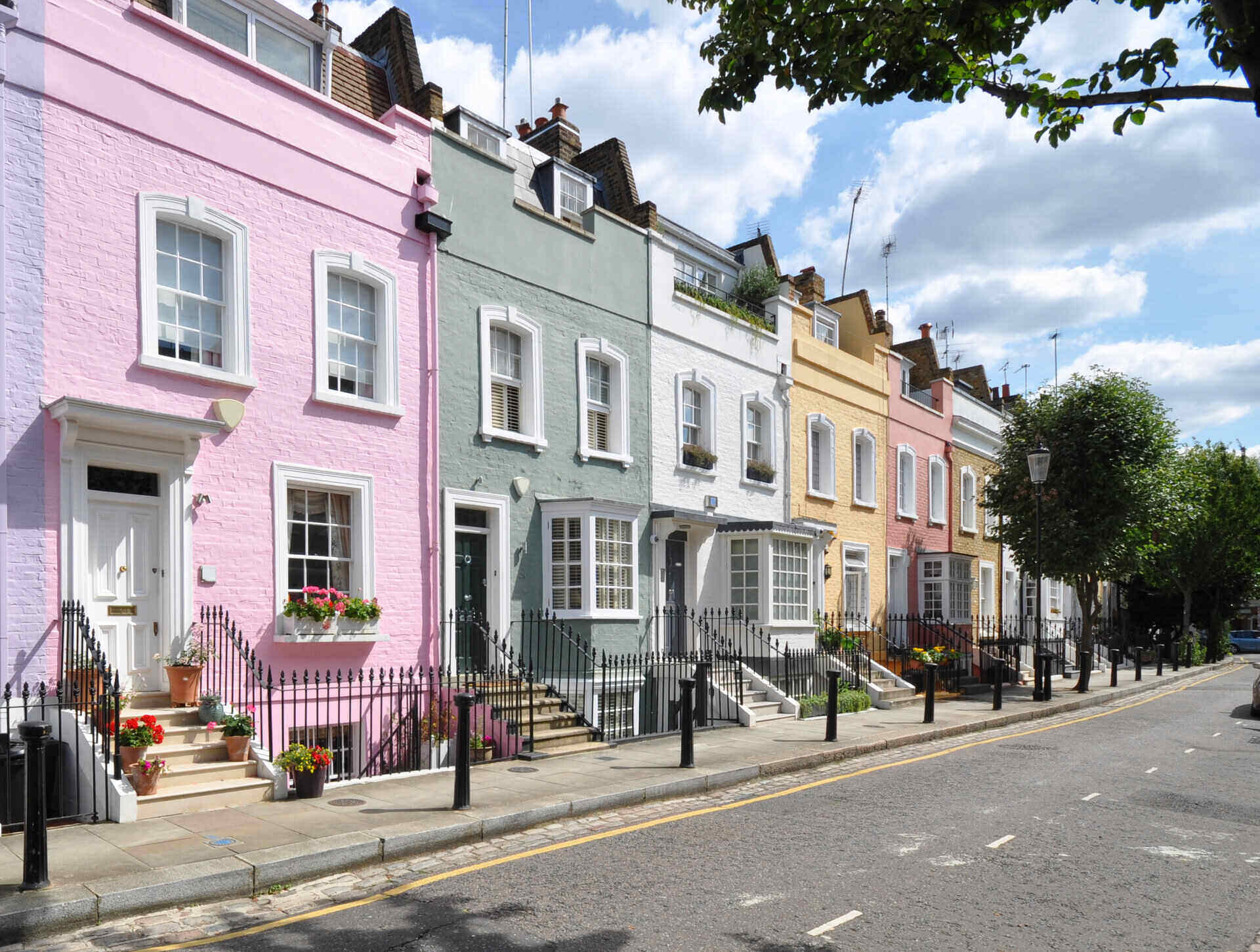
This is our guide to Chelsea’s SW3 postcode — what the area actually covers, how to get around, the schools, the property types, and what the numbers say about prices, for anyone planning a move here. SW3 covers the eastern and central part of Chelsea — roughly from Sloane Square across to Beaufort Street, with the Thames as its southern edge and Brompton Road/Fulham Road marking the top. The World’s End area, further west along King’s Road, is Chelsea too but sits in the neighbouring SW10 postcode — worth knowing if you’re comparing addresses, since a flat that says “Chelsea” in the listing isn’t necessarily SW3.
We’ve been moving people in and out of Chelsea since 2002, and the questions we get asked on survey day are rarely about the King’s Road shops. They’re about whether a removal lorry can actually get down a mews street, whether the flat’s lift will take a sofa, and where on earth you’re supposed to park. This guide answers the questions that actually matter.
Chelsea SW3 Areas: Sloane Square to Beaufort Street
Treat Chelsea as one uniform stretch and you’ll misjudge your move. Around Sloane Square, at the eastern edge, you’ve got Peter Jones, the Royal Court Theatre, and the start of King’s Road — the most polished part of the postcode. Further along King’s Road and Royal Hospital Road is the historic core: Duke of York Square, the Saatchi Gallery, the Royal Hospital grounds. Towards the SW3/SW10 boundary at Beaufort Street, things get quieter and more residential.
Where you land within that stretch changes how you should think about parking, noise, and which primary school is realistically walkable.
Chelsea SW3 Transport: Tube, Bus, and Parking for Removals
Sloane Square, South Kensington and Knightsbridge are the three stations you’ll actually use, and depending on where in SW3 you land, each is roughly a 10 to 15 minute walk.
Sloane Square (District and Circle lines) covers east Chelsea and the start of King’s Road. South Kensington (District, Circle, Piccadilly) serves the northern edge. Knightsbridge (Piccadilly line) sits right on the postcode’s northern boundary — its official address is Sloane St, London, SW3 1ED. Imperial Wharf, on the London Overground, serves the southwestern corner near Chelsea Harbour. Buses fill in the rest — routes 11, 19, 22, 49, 211 and 319 run the length of King’s Road and Fulham Road, and are the quickest way to get around south of Brompton Road, where all three Tube stations sit some distance away.
Driving is the part that genuinely trips people up on moving day. Most streets are resident-permit zones, on-street parking is scarce, and several of the prettiest addresses — mews houses especially — were built for horses and carts, not seven-tonne lorries. We book parking suspensions and loading bay permission in advance for every Chelsea job, because turning up on the day and hoping for a space isn’t a plan.
Best Schools in Chelsea SW3: Primary, Secondary and Independent
Kensington and Chelsea runs some of the tightest primary school catchments in London, drawn street by street rather than by postcode. If a specific school is part of why you’re moving, check current catchment maps and admissions criteria directly with the school or the council — don’t take our word, or anyone else’s, on distance alone.
With that caveat, here’s what serves the area:
State primaries: Park Walk Primary School, Christ Church and Holy Trinity CofE Primary Schools (a federation covering Robinson Street and Sedding Street), Marlborough Primary School on Draycott Avenue, St Joseph’s Catholic Primary School and Oratory RC Primary School. Note that Ofsted retired its old single-word “Outstanding/Good” judgements in November 2025 in favour of a multi-area report card, so check each school’s current report directly on reports.ofsted.gov.uk rather than relying on any historic rating you might see quoted elsewhere.
Secondary schools: Chelsea Academy is the RBKC state secondary nearest the World’s End end of the borough — its address is actually just over the boundary in SW10, on Lots Road. More House School is a well-regarded independent Catholic girls’ secondary in Chelsea itself. The Cardinal Vaughan Memorial RC School and Kensington Aldridge Academy, both strong performers, sit a short journey away in Holland Park and North Kensington.
Independent and international schools: Hill House International Junior School on Hans Place is one of the best-known prep schools in the country. Cameron Vale School (formerly Cameron House), Garden House School and Falkner House all have long-standing reputations locally. Families relocating from France often ask about the Lycée Français Charles de Gaulle in South Kensington, a short journey from SW3.
Registration for the sought-after independent schools often closes a year or more before entry — if a school is part of the plan, start that conversation before you start the house search, not after.
Things to Do in Chelsea SW3: Attractions and Landmarks
King’s Road is the spine of the area, running from Sloane Square in SW3 through to World’s End (which, as above, is technically SW10) — and it’s changed character more than once: a private royal road first, then the centre of 1960s fashion, then punk. The original Vivienne Westwood shop, still trading under the name Worlds End, is at the far western end of this stretch. Today the road is a mix of designer names and independent shops, with the concentration thinning out the further west you walk.
Beyond the shopping: the Saatchi Gallery, inside the Duke of York’s HQ, has some exhibitions with free entry, though headline shows are usually ticketed (typically £5–£16, with concessions available). The Chelsea Physic Garden, founded in 1673 and tucked behind high walls off Royal Hospital Road, is London’s oldest botanical garden and genuinely worth the ticket price in late spring. The Royal Hospital Chelsea, home to the Chelsea Pensioners since 1692, hosts the RHS Chelsea Flower Show every May. The National Army Museum is free and a few minutes from the Physic Garden. Duke of York Square runs a Saturday food market. And Cheyne Walk, running along the river, is one of the most photographed residential streets in London for good reason — though note the western stretch of Cheyne Walk, past Beaufort Street, is in SW10 rather than SW3.
If football matters to your household, Chelsea FC’s Stamford Bridge and its museum are close by — worth knowing that the ground itself is actually in Fulham, postcode SW6, not SW3.
Chelsea SW3 Removals: What Actually Affects a Move Here
It’s tempting to reach for a “Chelsea vs the rest of London” comparison, but that flattens a lot of real variation — plenty of London addresses have their own parking permits, period stock, and access quirks. What’s genuinely worth planning around for an SW3 move is more specific than that:
| Factor | What it means for your move |
|---|---|
| Conservation area coverage | Kensington and Chelsea has 38 conservation areas covering roughly 70–73% of the borough — one of the highest concentrations in London. If you’re renovating after moving in, assume you’ll need planning permission rather than relying on permitted development rights. |
| Listed buildings | Around 3,800 listed buildings borough-wide. If yours is one of them, alterations (even internal ones) may need listed building consent — worth checking before you commit to any post-move works. |
| Parking suspensions | RBKC doesn’t legally require a suspension for a domestic removal — you can use an ordinary bay or yellow line if you find space and don’t obstruct it. A suspension guarantees you a space instead of hoping one’s free. As of the last published RBKC fee schedule, suspensions cost from £72 per space for each of the first 5 days, rising for longer bookings, and need 10 working days’ notice for a resident bay (rates increase periodically, so check RBKC’s current fees before budgeting). |
| Building access | Mews houses and mansion blocks are common enough in SW3 that it’s worth checking lift dimensions, staircase width, and any doorway restrictions on a listed building before survey day — these vary property to property rather than being a single borough-wide rule. |
Chelsea Property Types: Georgian Houses, Mansion Blocks and Mews Houses
SW3 is overwhelmingly period housing, and the type you end up in shapes the move more than almost anywhere else we work. Georgian and Victorian terraces, a good number of them listed, cluster around Cheyne Walk, Chelsea Square and the streets off King’s Road. Red-brick mansion blocks near Sloane Square typically come with porters, lifts and a service charge worth budgeting for from day one. Mews houses, tucked behind the main streets, are a distinctly Chelsea housing type and often the trickiest for access. Garden-square flats overlook private communal gardens that residents fund and maintain themselves.
Kensington and Chelsea’s conservation areas cover roughly 70–73% of the borough, and around 3,800 buildings are listed borough-wide — SW3 accounts for a large share of both. Planning permission requirements here are stricter than in most of London as a result, which matters practically if you’re planning to renovate after you move in.
Chelsea Property Prices: What SW3 Homes Are Actually Selling For
Estate agent guide prices are one thing. What people actually paid, recorded by HM Land Registry, is another — and it tells a more precise story than the headline “Chelsea is expensive” line. Over the twelve months to 31 March 2026, the average sold price across the SW3 postcode was £2,013,225.
Average Chelsea House Prices by Property Type
Broken down by property type, the picture across Chelsea more broadly (HM Land Registry’s Chelsea area, which closely tracks SW3) looks like this:
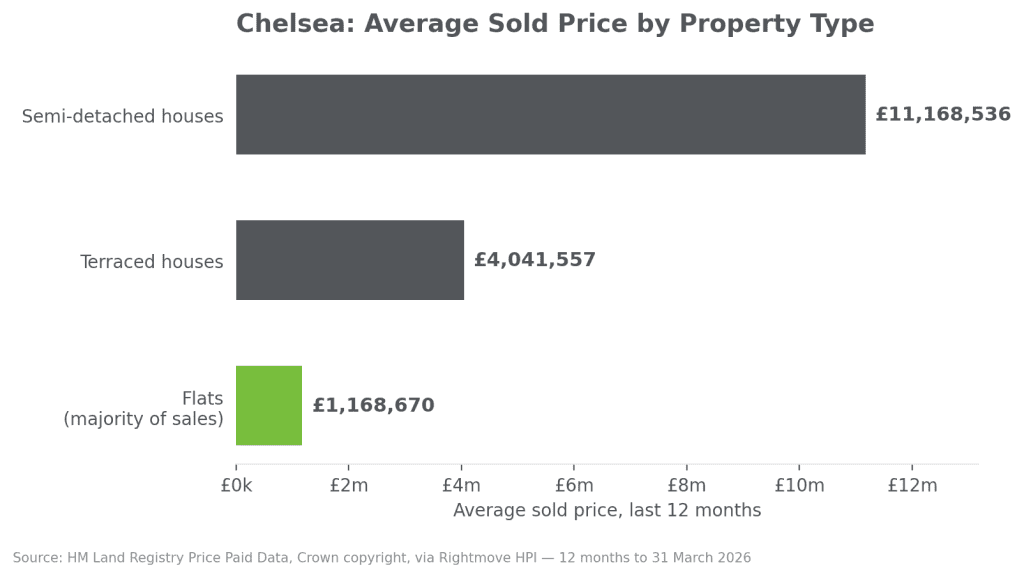 Flats make up the majority of Chelsea sales and sit at a very different price point to the borough’s houses — a gap worth knowing before you set a budget based on “average Chelsea price” headlines, which tend to be skewed upward by a small number of high-value house sales.
Chelsea House Prices vs the 2022 Peak
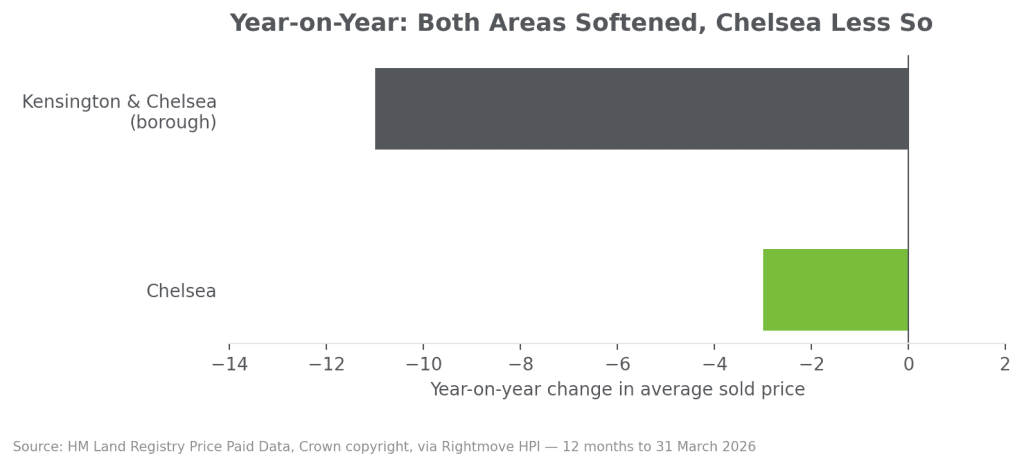
Sold prices in Chelsea were down 3% on the previous year, and down 22% on the area’s 2022 peak.
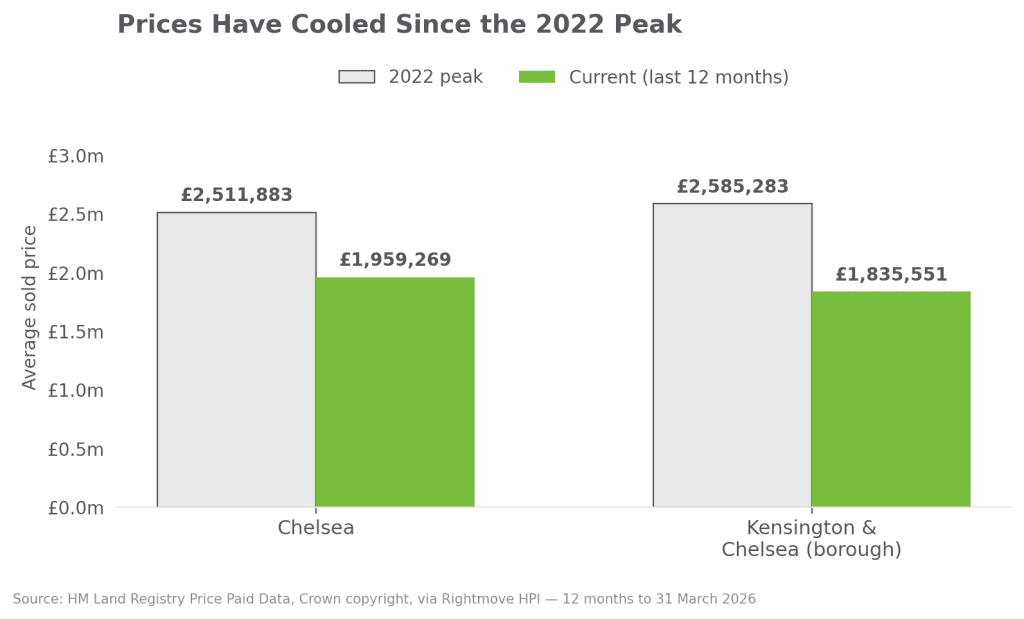 Zoom out to the whole of the Kensington and Chelsea borough and the fall is sharper still — down 11% year-on-year and down 29% on its own 2022 peak, with a borough-wide average flat price of £1,175,166. Chelsea itself has held up somewhat better than the borough average, which fits what we see on the ground: SW3’s mix of listed period stock and low turnover makes it more resistant to swings than newer-build pockets elsewhere in the borough.
SW3 House Price Trends: Year-on-Year Change
 A caution worth repeating to anyone reading street-level data: individual street figures on a small sample size swing wildly. Tite Street, for instance, shows terraced sales up 323% year-on-year — not because the street got more valuable, but because only a handful of transactions happened, and the property type mix which sold happened to be pricier that year. A single street with two or three sales a year is not a reliable trend line; the postcode or area-level figures are.
Source: HM Land Registry Price Paid Data, Crown copyright, via Rightmove’s House Price Index tool, data covering transactions to 31 March 2026, published 15 May 2026.
Chelsea SW3 Removals Checklist: Before Moving Day
A few things worth sorting before the van arrives:
- Check your building’s access — lift dimensions, stair width, any restrictions on a listed doorway — and tell your removal company before survey day, not on the day itself.
- Assume you’ll need a parking suspension or loading bay booking; don’t assume you’ll find a space.
- If your new home is smaller than what you’re used to, which is common moving into a period Chelsea flat, think about storage early rather than as an afterthought.
- Weekday moves are considerably easier to manage than weekends, when King’s Road and Duke of York Square are at their busiest.
If you’re planning a move into SW3, get in touch for a survey — our team knows the access quirks of the area’s mansion blocks, mews houses and listed buildings, and we’ll plan around them rather than find out about them on the day.